

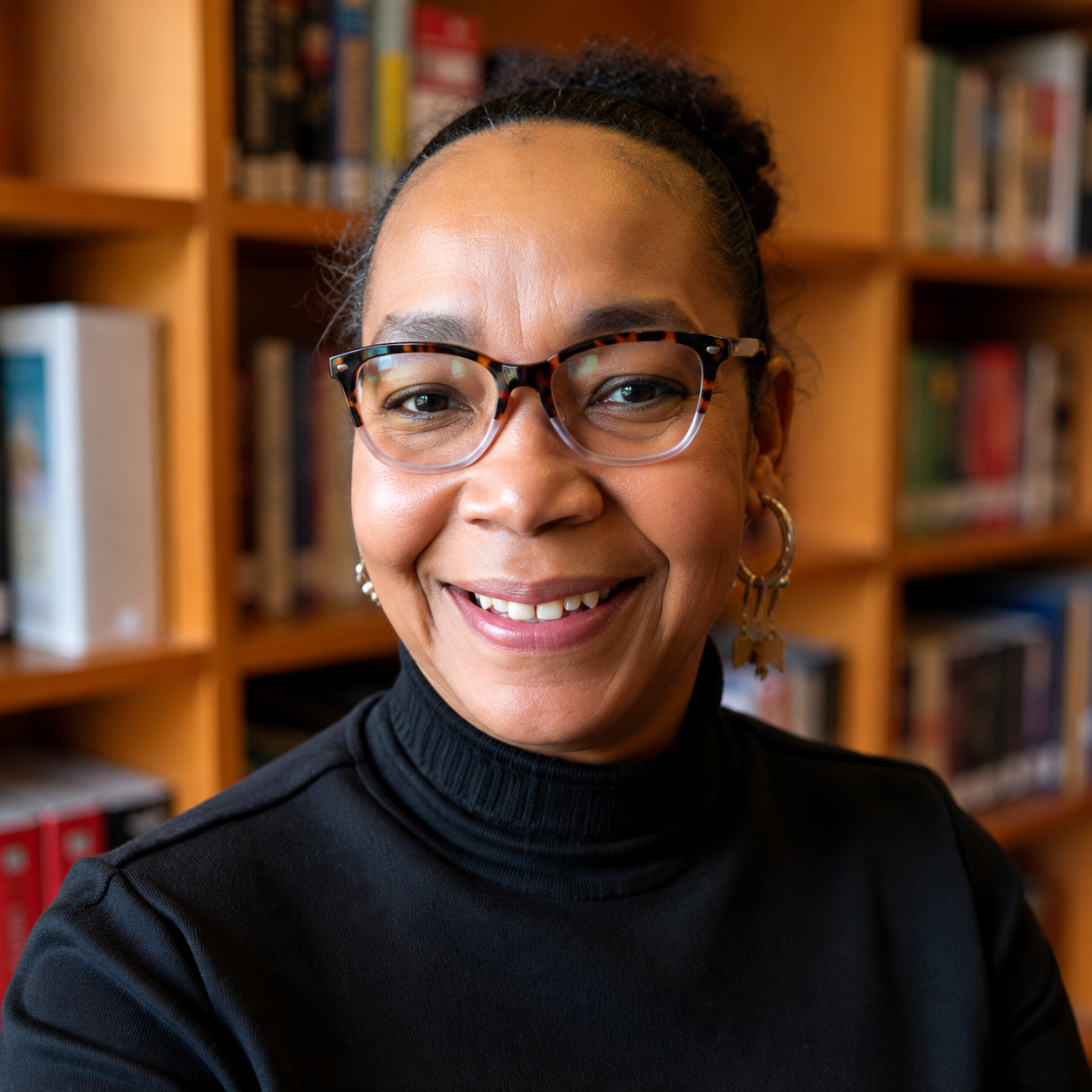
An Uncomfortable Truth with Monique Harrison
Monique Harrison was walking the aisles of a classroom that was not hers. The kids in that room, she noticed, had not seen many adults who looked like her. She was there because the teacher at the front had been assigned mathematics she did not know, and helping with that is Monique’s job. One little Black girl looked up at her and said it.
“Math don’t like me.”
Not I don’t like math. Not math is hard, not math is my worst subject — Monique, like many teachers, has heard those a thousand times, and they are ordinary. This ran the other direction. This child had concluded that the discipline had an opinion about her, that a verdict had already been entered, and that she was the party who had lost. “That hit me,” Monique said. “I will never forget that. I will carry that. How do I answer that for her?” Hold onto the question. It takes thirty-six years to answer, and the answer is not the one you would guess.
Why she was in the room
Monique is starting her thirty-sixth year in education. For the last four years, she has been a district secondary mathematics specialist, which means she goes into middle and high schools to coach teachers, train teachers, sit in classrooms, sometimes co-teach a lesson to show what it can look like. What she keeps finding is teachers who are not mathematics content specialists teaching mathematics. So this past year she wrote a course to help middle school teachers earn their middle-level certification. She held office hours. A few teachers came and did real work.
“The ones that I wrote the class for didn’t come.”
One of them was a second-grade teacher who had been placed in seventh-grade math. Read that again slowly. Not a teacher who let her certification lapse, not a teacher coasting — a person trained for seven-year-olds, put in front of twelve-year-olds, and told to teach them ratios, negative numbers, and the division of fractions. Somebody made that placement. Somebody signed it. In our work across the US, this is all too common, and it hides both the scarcity and vacancy numbers. And then the correction was left to Monique, one classroom at a time, on her own initiative, in courses she wrote herself that the people who needed them did not attend. That is the floor underneath the little girl’s sentence. Before a child can decide that mathematics has rejected her, an adult has to have made a staffing decision. The child experiences it as a fact about herself and the universe. It was a fact about a staffing spreadsheet.
What she knew before school
To understand why Monique hears that sentence the way she does, you have to go back a long way (well maybe not that long). Her grandfather was a carpenter and a deacon in Muskogee, Oklahoma — an intricate, detailed carpenter, she says, the kind who cares how a joint sits. She would be on his lap while he read the Bible. She was on his lap while he built. He taught her to read a ruler. He taught her fractions before anybody taught her anything. She was reading at three. She knew multiplication at four. Then she turned five, and she was not allowed to go to the public school. All the Black children went to Miss Sessions’ house. That is how she tells it, plainly, with no elaboration, the way you describe weather. Miss Sessions knew she was smart, period. She got in trouble a lot because she talked all the time, but that was the only complaint. When they allowed them to go, she started public school in first grade, and she got in trouble there too — because it was too easy, she says now, looking back. She was pulling hair. She was doing all the things.
Her mother worked for the Air Force, so the family moved. Fifth grade was Oklahoma City, the year busing started; she lived on the white side of town and got bused to the Black side. That was Miss Katon’s classroom, and we will come back to it, because everything comes back to it. Then Delaware. Sixth grade. “I had a science teacher who really believed that black girls should not be as smart as I was. And it hurt. And I remember it to this day. I remember the teacher.” Seventh grade was not much better. Here is what she says that sentence did to her: “That right there made me question whether or not I should show people I’m smart.” She was eleven years old and doing arithmetic on whether to hide. She did not hide. She took it — “I felt like I was taking abuse, but I did it, and I got my A’s” — and then she went to college and majored in physics. She walked straight into the subject those teachers had told her she did not belong in, and she took a degree in it. It did not stop there. At a community college, in analytic geometry, she sat in the front row, took the first test, and did worse than she was used to. The instructor looked at her and told her that if she failed the test, she should go ahead and drop the class.
“I don’t fail tests, so what’s up?”
She studied how he graded. Then she set the curve on every remaining test in the course. “If you’re going to challenge me as a black student, as a girl — I’m going to meet you and surpass everything that you think you know of me.” That is thirty-six years of professional life described in one sentence, and it has a cost inside it that nobody names. Somewhere in there she stopped performing. She used to do the grocery math for her mother, running the total in her head down to the penny by the time they reached the register. She does not do that anymore. People still ask.
“You have calculators now. You have a phone. Ask it. I’m no longer doing three times three multiplication. I’m not doing that for you anymore.” A woman spends her whole life being asked to prove it. Eventually she declines to keep proving it. That is not arrogance. That is a bill coming due.
What she sees when she walks in
Monique is certified in all nine of Oklahoma’s mathematics examinations. She is National Board certified. She is the president of the Benjamin Banneker Association, the NCTM equity affiliate founded in 1986 to advocate for Black children in mathematics — an organization she came to through Dr. Pamela Seda, whose own conversation appeared earlier in this series. She has written the secondary mathematics frameworks for her district, all of them, with the student misconceptions built into the documents so a teacher does not have to go looking. And she still has to say this out loud: before you teach it, do the math. “Do the math. Understand. Try to figure out what misconceptions students might get. They don’t even have to think, they just have to read the paper. But they still need to do the math. If you’re going to teach it, do the problems before you give them to the kids.” Then there are the tricks, which she has a real issue with. She was walking past a classroom and heard a teacher saying it to seventh graders, over and over, like a chant: keep, change, flip. She walked in. She was dressed for something that day — polka-dot chiffon sleeves, a fur vest, a polka-dot skirt, the boots, the whole thing. She went to the teacher and asked her to use mathematical words instead. Reciprocal. Say what the operation is. Then she told her what would happen. They are going to come in tomorrow and keep-change-flip everything. They will keep-change-flip when they add. They will keep-change-flip when they multiply. They will keep-change-flip all over the place. “And she had to come back to me and say that’s exactly what they did.”
Monique’s diagnosis of why tricks spread is not that teachers are lazy. It is that a generalist has not been given the shape of the thing. “When we get K–12 teachers that are generalists, they don’t know where it goes. When kids start asking those questions, you don’t know where it went or where it came from.” She can teach sixth grade and tell you exactly what those students will be doing in seventh, eighth, and ninth. That is not a personality trait. That is what knowing a discipline vertically looks like, and it is the difference between a procedure and a coherent story. It shows up in smaller ways too, and she notices those. She was observing a classroom, videotaping, and saw a girl in the back doing nothing. It looked like defiance. The teacher never went back to check on her, not once. Monique finally walked back herself. The girl needed a charging cord. Monique asked out loud who had one, plugged her in, and the girl worked. Afterward, she looked around the room and found no personal items, and she took down some posters from the 1970s about math and learning that she had put up herself. In the conversation that followed, the teacher said the kids just did not like him. “What do they know about you? You have nothing up here.” Did he have pets? A cat. Did the kids know about the cat? No. Why not? She is careful to add that he had come from another country, and that some of this is a training problem rather than a character problem. She offers that on his behalf. Notice that she does that.
The part that costs her
Here is the uncomfortable truth, and it is not the one about tricks. Monique is now the person who walks into a room and renders the verdict. She is the one who says, in effect, “You do not know this mathematics, and children are being harmed by that.” She is right. That is the difficult part. Somebody has to say it, because the alternative is a seventh grader learning a chant instead of an operation, and a second grader’s teacher being set up to fail in front of thirty kids, and a little girl in the back of the room concluding that math does not like her.
And Monique, of all people, knows exactly what that verdict feels like on the receiving end. She was eleven years old in a room with an adult who had decided what she was capable of. She has been told to drop the class. She has had to stop using the phrase she used to use.
“I’ve had to stop saying that, because I’ve hurt people’s feelings.”
The phrase was real math teachers. She said it once in a job interview at a private school that had a college English professor and a college physics professor teaching the mathematics — well, if I’m here, you’ll have a real math teacher — and she did not realize she had said it until after they hired her and told her so. She has had to watch herself around her own middle school teachers, because they are K–8 certified and, to her, teaching mathematics requires the middle-level endorsement. They are certified. Legitimately, fully certified. That is the sequel nobody wants to write. The credential can be in place entirely, and the mathematics can still be missing, because a credential certifies a person, and coherence lives in practice. Monique can see the gap from across a hallway. Naming it is her job. Every time she names it, it lands on somebody who did nothing wrong except accept the assignment they were given, and she is the one who has to watch their face.
The 99
Fifth grade, Oklahoma City, Miss Katon’s room. Monique can still see her directing the choir — she conducted with her middle fingers, which a ten-year-old does not forget. Miss Katon got her a sixth-grade math book, then a seventh-grade math book, then had to invent something else to do with her. She had her read books onto a tape recorder so the kindergarteners downstairs could hear a kid’s voice reading to them. Monique joined the choir that year and started playing the viola, which led to a full music scholarship. That was also the year of the California Achievement Test. When the scores came back, Monique had a 99, and she cried. Hard. Full-blown. Because it was not a hundred, and she knew she had gotten every single question right. Miss Katon sat down and explained percentiles to a ten-year-old. That means ninety-nine percent of the people were below you.
“Oh — that means I am number one.”
Yes.
She had not been able to read the instrument that was measuring her. It said one thing to the system and something else entirely to the child, and the distance between those two readings was closed by one adult who noticed a kid crying and decided to explain the mathematics. Twelve years later, Monique was twenty-two, in the district office signing her first teaching contract, and heard someone call her full name across the room. It was Miss Katon, walking with the superintendent. She recognized her. She called her over, and then she told the superintendent the story about the girl who cried over a 99.
“She remembered me.”
What she wanted to know
At the end of our hour, after thirty-six years, a national presidency, nine certifications, National Board, a doctorate she is planning to go get in data science, and a deanship starting this fall, Monique said this:
“I hope I said something that was worthy.”
Earlier she had explained why being asked mattered so much. Being seen, she said — that is a Black woman thing. People do not see us. And when we are seen, it is oh my goodness, what did I do? — because we do not think we are doing anything. We just do what we know to do. So here is the answer to the little girl in the back of the classroom, the one who said math don’t like me. Monique has it ready, and she says it as a fact because, to her, it is one.
Math loves you.
The harder question is the one the child asked without meaning to. Somebody taught her otherwise. Who was in the room, and who put them there?
Monique Harrison is a district secondary mathematics specialist entering her thirty-sixth year in education and the president of the Benjamin Banneker Association. She is National Board certified, holds Oklahoma certification in all nine mathematics
examinations, and has taught middle school, high school, and AP Statistics. She becomes a school dean this fall.