

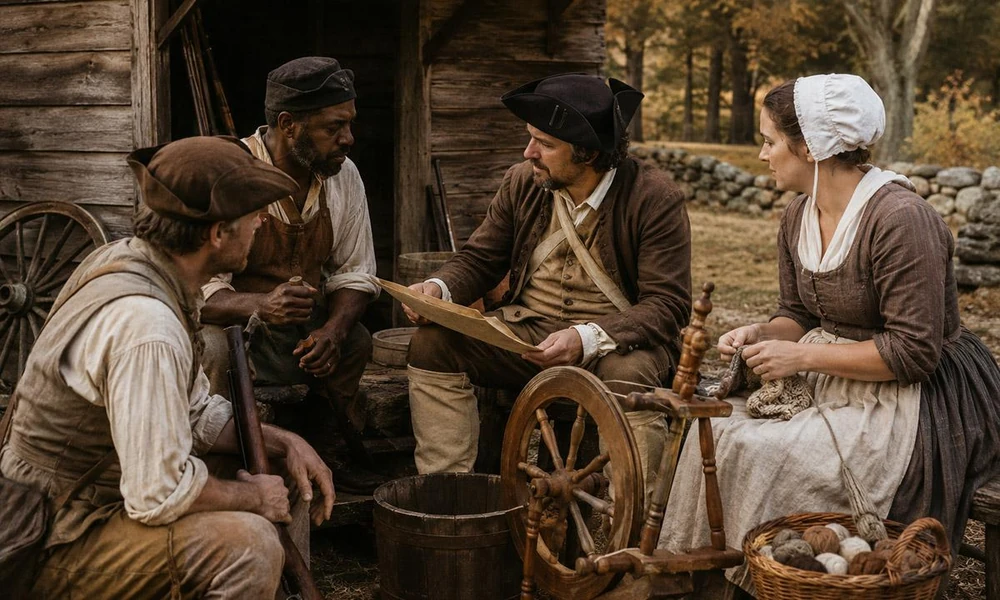
The Revolution expanded beyond political leaders as farmers, artisans, women, laborers, sailors, enslaved people, and local communities entered the struggle.
The history of the American Revolution is often told through famous people such as George Washington, Thomas Jefferson, Benjamin Franklin, John Adams, and Samuel Adams. These individuals played crucial roles, but the revolutionary movement could not have succeeded through leadership alone.
Ordinary colonists supplied the labor, money, food, information, military service, and political participation that sustained resistance. They attended town meetings, enforced boycotts, joined militias, signed petitions, manufactured goods, sheltered soldiers, spread news, and challenged loyalist neighbors.
The Revolution also created opportunities and dangers for people whose goals did not always align with those of patriot leaders. Enslaved people sought freedom. Indigenous nations defended their homelands. Women assumed expanded economic responsibilities. Tenant farmers and laborers sometimes connected imperial resistance with local grievances.
The revolutionary cause therefore did not represent a single experience shared equally by everyone. It was a collection of overlapping struggles shaped by class, race, gender, geography, and political belief.
Understanding how ordinary people became involved reveals why the Revolution became a mass movement rather than a narrow dispute among elites.
Local Politics Made Resistance Accessible
Colonial political life often operated through local institutions. Town meetings, county courts, churches, taverns, markets, and militia gatherings provided spaces where residents could discuss public issues.
In New England, town meetings allowed eligible male voters to debate taxes, elect officials, and pass resolutions. In other regions, county governments and local associations played similar roles.
As resistance to British policy intensified, these institutions became channels for mobilization. Communities debated the Stamp Act, approved boycott agreements, selected delegates, and created committees of correspondence.
Political participation was still limited. Voting requirements excluded many men, and women could not vote. Enslaved people and most Indigenous people were outside colonial political institutions entirely.
Nevertheless, revolutionary politics reached beyond formal voters. Public meetings attracted large crowds. Newspapers were read aloud. Sermons addressed imperial controversies. Taverns served as centers of news and debate.
Local committees gave ordinary residents practical responsibilities. Committee members monitored imported goods, collected supplies, communicated with neighboring towns, and investigated political loyalty.
These activities taught colonists how to organize outside royal authority.
Artisans and Laborers Gave Resistance Its Street-Level Power
Urban artisans and laborers were central to the protest movement. Printers, shipbuilders, rope makers, blacksmiths, carpenters, dockworkers, and sailors often experienced imperial trade regulations directly.
Many supported the Sons of Liberty and participated in demonstrations against the Stamp Act and Townshend duties. Their numbers gave public protests visibility and force.
Artisans also connected political liberty with economic independence. British manufactured goods competed with colonial production. Boycotts created opportunities to promote local crafts and reduce dependence on imports.
The homespun movement benefited weavers, spinners, and textile producers. Local manufacturing became a patriotic activity.
Urban workers also had their grievances. British soldiers sometimes competed for part-time employment, contributing to tension in cities such as Boston. The Boston Massacre began in an environment shaped partly by conflict between soldiers and local laborers.
Ordinary protesters did not always follow elite direction. Crowd actions could become more aggressive than colonial leaders intended. Attacks on officials and property revealed that popular resistance had its energy.
Patriot leaders depended on crowds to make British laws unenforceable, yet they also feared that social unrest could challenge colonial hierarchy.
The Revolution became a mass movement when political arguments left legislative chambers and entered workshops, docks, markets, taverns, and neighborhood streets.
Women Made Resistance Possible at Home and in Public
Women were excluded from formal political office, but their participation was essential to the revolutionary cause.
Boycotts depended on household consumption. Women often decided which textiles, food products, and household goods families purchased. Refusing British imports required them to find substitutes, repair existing items, and produce goods locally.
Women organized spinning bees, made homespun cloth, reduced tea consumption, and supported nonimportation agreements. These activities transformed domestic labor into political action.
During the war, women managed farms, shops, workshops, and family finances while men served in the army or militia. They produced clothing, prepared food, cared for wounded soldiers, and followed military camps.
Some women served as nurses, cooks, laundresses, messengers, or spies. Others directly entered combat, sometimes disguised as men or assisting artillery crews during emergencies.
Abigail Adams famously urged her husband John Adams to “remember the ladies” when creating new laws. Her appeal reflected a broader question: if the Revolution challenged inherited authority, would it also change women’s political status?
The immediate answer was limited. Women did not gain national voting rights, and legal traditions continued to restrict married women’s economic independence.
However, the Revolution encouraged greater attention to women’s education and civic influence. The idea of republican motherhood held that women had an important responsibility to raise informed and virtuous citizens.
This concept recognized women’s political importance while still confining that importance largely to the household.
Farmers and Militia Members Turned Resistance Into War
Most colonists lived in rural communities. Farmers supplied food, horses, wagons, labor, and military manpower.
Local militias had existed before the Revolution. They were intended to provide community defense and generally included adult white men within specified age ranges.
As the imperial crisis worsened, militia companies trained more frequently and stored weapons and ammunition. In Massachusetts, specially prepared minutemen were expected to mobilize quickly.
When British troops marched toward Concord in April 1775, local alarm networks spread the news. Riders, church bells, drums, and messengers called militia members to assemble.
The men who confronted British forces at Lexington and Concord were not professional soldiers. They were farmers, craftsmen, shopkeepers, and local residents.
After the fighting, thousands of militia members traveled toward Boston and helped begin the siege of the city.
Militia service allowed ordinary colonists to defend their communities, but it could also be disruptive. Men had to leave farms and businesses, while families absorbed the economic consequences.
As the war continued, the Continental Army struggled with enlistment, desertion, supply shortages, and inconsistent pay. Soldiers often served under difficult conditions.
Many joined for a mixture of reasons: political conviction, community pressure, wages, land promises, adventure, or economic necessity.
Enslaved People Pursued Their Own Revolutionary Goals
The language of liberty created a profound contradiction in a society where slavery remained legal.
Enslaved people recognized that the imperial conflict might create opportunities for freedom. Some petitioned colonial legislatures, using revolutionary arguments about natural rights to challenge slavery.
In November 1775, Virginia’s royal governor, Lord Dunmore, issued a proclamation offering freedom to enslaved men owned by rebels who joined British forces. Thousands of Black people eventually sought protection behind British lines.
The British offer was strategic, but it gave enslaved people a path to act on their own desire for freedom. Black loyalists served as soldiers, laborers, guides, pilots, and support personnel.
Other African Americans served in patriot forces. Free Black men and some enslaved men fought in the Continental Army and state militias. Rhode Island formed a regiment that included many Black and Indigenous soldiers.
Individual decisions depended on local conditions, personal opportunities, and the likelihood that one side could provide freedom.
The war disrupted slavery in some areas and contributed to gradual emancipation in several northern states. In the South, however, slavery survived and later expanded.
The Revolution’s promises therefore remained deeply incomplete.
Indigenous Nations Faced a Threat to Their Homelands
Indigenous nations did not simply choose between Britain and the colonies based on loyalty to one government. They evaluated which side posed the greater threat to their land and sovereignty.
Many Native leaders viewed colonial expansion as the central danger. The British Proclamation of 1763 had attempted to restrict settlement west of the Appalachian Mountains, while colonists repeatedly pushed into Indigenous territory.
Some nations allied with Britain because they believed a British victory might better restrain American settlement. Others supported the patriots, remained neutral, or divided internally.
The Haudenosaunee, or Iroquois Confederacy, was split by the war. The conflict damaged communities, divided families, and weakened longstanding political relationships.
American victory did not bring liberty to Indigenous nations. It accelerated western settlement and led to new land seizures and military campaigns.
For Native communities, the American Revolution was often a struggle to protect sovereignty against expanding settler power.
The Revolutionary Cause Was Built Through Unequal Participation
Ordinary people made the Revolution possible, but they did not all receive equal benefits from its outcome.
White male political participation expanded in many states over time. Ideas about equality and consent became central to American political culture.
Women gained greater recognition for their civic influence but remained excluded from formal political power. Enslaved people used revolutionary language to challenge bondage, yet slavery endured. Indigenous nations faced continued dispossession.
Loyalists also experienced the Revolution as loss. Some were harassed, had property confiscated, or fled the United States.
The revolutionary cause succeeded because it mobilized diverse communities, but those communities entered the struggle with different expectations.
Ordinary colonists did not simply follow the Revolution. Their labor, choices, sacrifices, and competing goals determined what the Revolution became.
Frequently Asked Questions
Who counted as an ordinary colonist?
The term includes farmers, artisans, laborers, sailors, shopkeepers, women, militia members, servants, enslaved people, and others outside the most famous political leadership.
How did people participate without fighting?
They joined boycotts, produced supplies, attended meetings, spread news, managed farms, collected money, cared for soldiers, and served on local committees.
Did all colonists support independence?
No. Colonists were divided among patriots, loyalists, neutral residents, and people whose position changed over time.
Did women participate in the Revolution?
Yes. Women supported boycotts, managed households and businesses, produced supplies, followed military camps, gathered intelligence, and sometimes served near or in combat.
How did enslaved people respond to the Revolution?
Some joined British forces after being offered freedom, while others served with patriot forces or used revolutionary arguments to petition against slavery.
Explore the Revolution Through the People Who Lived It
The American Revolution was shaped not only by famous founders but also by thousands of people whose names rarely appear in traditional narratives.
Analyzing American Revolution examines the experiences of the farmers, artisans, women, soldiers, laborers, enslaved people, and Indigenous nations who gave the revolutionary era its complexity. Explore Analyzing American Revolution to understand how ordinary people turned political resistance into a social and military movement.